7 Surprising Benefits of Sleep on Mental Health You Never Knew

We all know sleep feels good. But did you know it may be one of the most powerful tools for protecting and improving your mental health maybe just as important as medication or therapy?
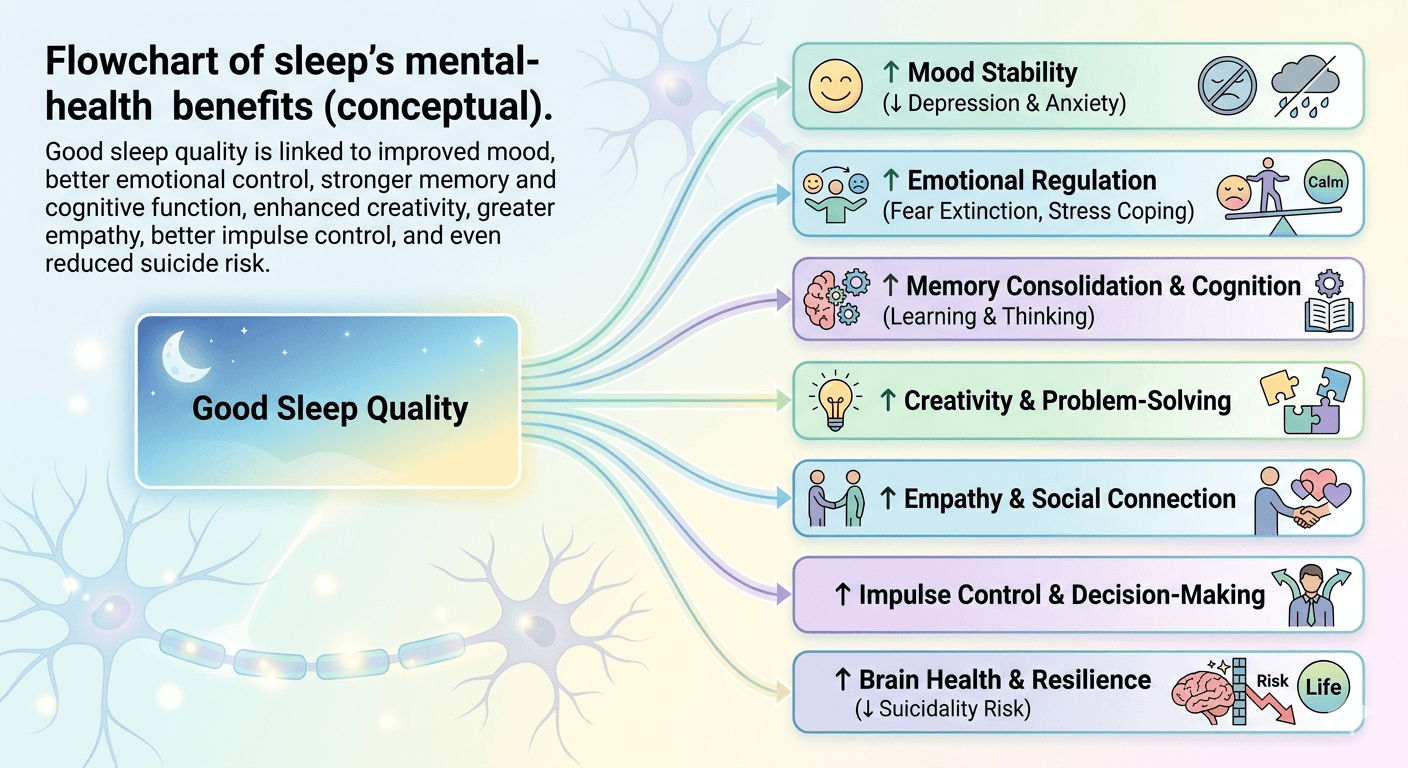
Research now shows that quality sleep does far more than rest your body. It resets your brain, stabilizes your emotions, and even lowers your risk of serious psychiatric conditions. Here are seven science-backed benefits of good sleep that might surprise you.
1. It Lifts Your Mood and Eases Depression and Anxiety
Sleep and mood are deeply connected. Studies involving thousands of adults consistently show that improving sleep leads to significant reductions in both depression and anxiety symptoms. In fact, treating insomnia alone, even without changing any other part of a patient's care, often produces meaningful improvements in mood.
Conversely, poor sleep disrupts the brain chemicals and stress hormones that regulate how we feel, leaving us more emotionally vulnerable.
What this means for you: If you are struggling with low mood or worry, your sleep quality may be making it worse. Addressing sleep is one of the first steps we explore in treatment.
2. It Helps You Handle Stress and Fear Better
Think of sleep as your brain's overnight reset button. During sleep, especially during the REM (dreaming) stage, your brain processes difficult emotions and rebalances the circuits that manage fear and stress. Well-rested people are better at telling real threats from minor ones, and they bounce back from stressful events more quickly.
Research has even shown that patients who slept well after therapy sessions reported greater reductions in anxiety the following week, compared to those who didn't.
What this means for you: Good sleep makes your coping strategies work better. It is not just rest, it is recovery.
3. It Sharpens Your Memory and Focus
During sleep, your brain consolidates everything you learned that day, moving information from short-term to long-term memory. Even one night of poor sleep can cause noticeable trouble with concentration, memory, and decision-making.
Over time, chronic sleep loss leads to real deficits in attention and mental sharpness; symptoms that are often mistaken for depression or ADHD.
What this means for you: If you find yourself forgetting things, feeling foggy, or struggling to focus, sleep may be a significant contributing factor worth addressing.
4. It Boosts Creativity and Problem-Solving
This one surprises many people. Studies show that people who sleep on a problem are significantly more likely to find creative solutions than those who stay awake working on it. During sleep, your brain makes unexpected connections between ideas, the kind that are hard to force when you are awake and focused.
What this means for you: If you are stuck on a difficult decision or personal challenge, a good night's sleep is productive.
5. It Improves Your Relationships
Sleep affects how we treat the people around us. Research published in 2025 found that even one night of disrupted sleep caused people to show less empathy and be less supportive toward others. Poor sleep tends to make us irritable, withdrawn, and harder to connect with, all of which can strain relationships and deepen feelings of isolation.
What this means for you: Improving your sleep can meaningfully improve your relationships with the people you care about most.
6. It Strengthens Your Self-Control
Sleep deprivation weakens the part of your brain responsible for judgment, impulse control, and rational decision-making; while activating the reward-seeking, impulsive parts. This is part of why people are more likely to overeat, engage in risky behaviors, or struggle with substance use when they are sleep-deprived.
A large study of over 74,000 adults found that people who consistently stayed up late had significantly higher rates of anxiety, depression, and other mental health conditions.
What this means for you: A consistent, earlier bedtime is one of the simplest and most evidence-based things you can do for your mental health and self-control.
7. It May Save Your Life
This is perhaps the most important benefit of all. Research shows that people with chronic insomnia or poor sleep have more than double the risk of suicidal thoughts and attempts compared to those who sleep well. Sleep disturbance is considered an independent risk factor for self-harm, separate from depression or other diagnoses.
The encouraging news is that treating insomnia has been shown to reduce suicidal ideation, even modestly. Sleep is not a small issue in mental health care. It is a critical one.
What this means for you: If you are not sleeping well, please tell your provider. It matters more than you may realize.
Simple Steps to Start Sleeping Better Tonight
You do not have to overhaul your entire life to improve your sleep. Start here:
Keep a consistent schedule: wake up and go to bed at the same time every day, including weekends
Limit screens for at least 30–60 minutes before bed
Keep your bedroom cool, quiet, and dark
Avoid caffeine after 2:00 PM
Try a short relaxation routine: deep breathing, light stretching, or journaling
Track your sleep and mood together: many patients are surprised to see the pattern
When to Talk to Your Psychiatrist About Sleep
If you have been struggling to fall asleep, staying asleep, or waking up unrefreshed for more than two weeks, especially if it is affecting your mood, work, or relationships, bring it up at your next appointment. Effective, non-habit-forming treatments are available, including Cognitive Behavioral Therapy for Insomnia (CBT-I), which has strong evidence behind it.
Sleep is medicine, not a luxury. And it is one of the most powerful tools we have.
Take the Next Step Toward Better Sleep and Better Mental Health
If you are experiencing poor sleep, anxiety, depression, or emotional burnout, you do not have to manage it alone. Our clinic provides comprehensive psychiatric evaluation and evidence-based treatment for sleep and mental health conditions, including:
Insomnia and chronic sleep difficulties
Anxiety and stress-related sleep disruption
Depression with sleep changes
PTSD-related sleep disturbance
Medication management for sleep when appropriate
Cognitive Behavioral Therapy for Insomnia (CBT-I)
Personalized treatment plans tailored to your needs
Improving sleep is often one of the fastest ways to improve mental health, and we routinely incorporate sleep-focused care into our treatment approach.
Schedule a consultation today to discuss your sleep and mental health goals.
Our team will evaluate your symptoms, review contributing factors, and develop a personalized plan to help you sleep better and feel better.
Better sleep can change your mood, your focus, your relationships, and your overall well-being. The first step starts with a conversation.
This blog is for informational purposes only and is not a substitute for professional medical advice. If you have concerns about your sleep or mental health, please contact our office to schedule an appointment.
References
Scott et al. Sleep Medicine Reviews (2021). DOI: 10.1016/j.smrv.2021.101556
Li et al. BMC Public Health (2025). DOI: 10.1186/s12889-025-23709-w
Guo et al. Journal of Affective Disorders (2026). DOI: 10.1016/j.jad.2026.121420
Goldstein & Walker. Annual Review of Clinical Psychology (2014). DOI: 10.1146/annurev-clinpsy-032813-153716
Paller et al. Annual Review of Psychology (2021). DOI: 10.1146/annurev-psych-010419-050815
Wagner et al. Nature (2004). DOI: 10.1038/nature02223
Lok et al. Psychiatry Research (2024). DOI: 10.1016/j.psychres.2024.115956
Dong et al. Psychosomatic Medicine (2021). DOI: 10.1097/PSY.0000000000000964