Breakthrough Study: Navigated TMS Boosts PTSD Recovery Rates by 44% in Combat Veterans
Breakthrough Study: Navigated TMS Boosts PTSD Recovery Rates by 44% in Combat Veterans
A landmark randomized clinical trial published in JAMA Network Open confirms what many in the psychiatric community have long hoped for — transcranial magnetic stimulation (TMS) can significantly improve outcomes for combat veterans with PTSD, even the most severe cases.
What the Research Shows
A new study out of San Antonio — right in our backyard — has produced some of the most compelling evidence to date that TMS therapy can play a transformative role in treating combat-related posttraumatic stress disorder (PTSD).
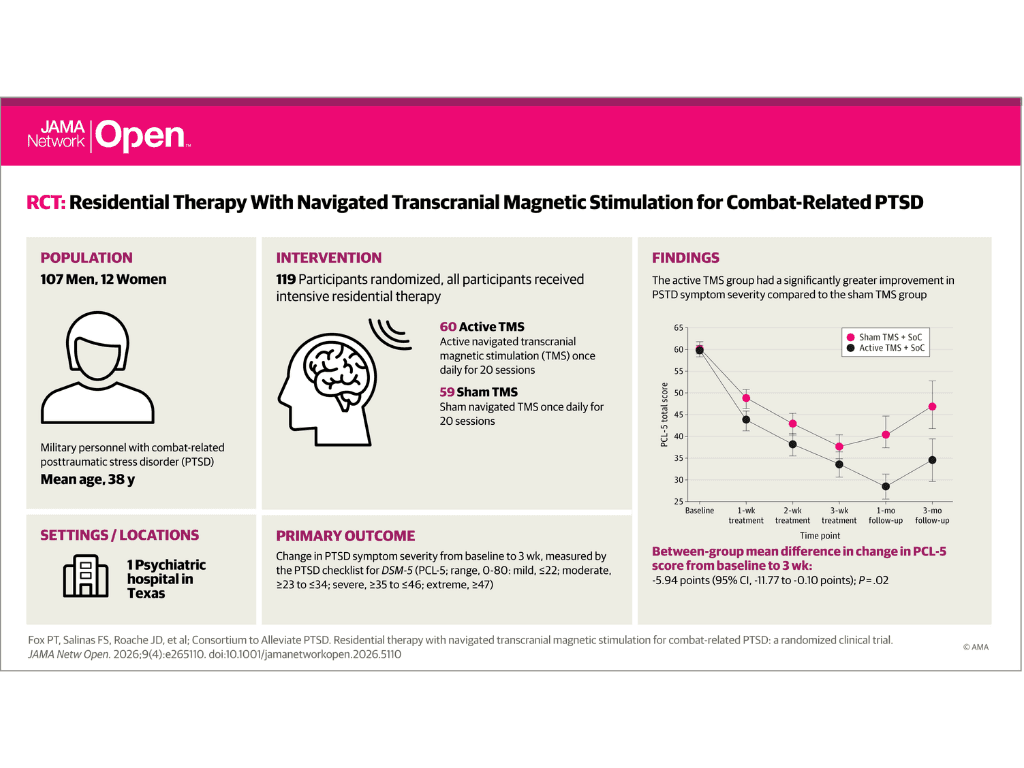
The trial, conducted at Laurel Ridge Treatment Center and led by researchers at the University of Texas Health Science Center at San Antonio, enrolled 119 active-duty military personnel and veterans with moderate to extreme PTSD. Published in April 2026 in JAMA Network Open, it’s the first randomized clinical trial (RCT) to test navigated TMS as an add-on to an intensive residential PTSD program.
The headline finding: 85% of patients receiving active TMS achieved clinically meaningful PTSD symptom reduction at one-month follow-up, compared to 59% in the sham (placebo) group. That’s a 44% relative improvement in recovery rates.
How the Trial Worked
All participants received an intensive 30-day residential treatment program as standard of care. This included:
Prolonged Exposure (PE) therapy — a trauma-focused, evidence-based approach administered twice weekly
Daily cognitive behavioral therapy (CBT) augmentations — structured day-long therapeutic activities to reinforce PE
Half of participants also received navigated TMS — a precision-guided form of brain stimulation delivered by a robotic system using each patient’s own MRI scans. The other half received sham (inactive) TMS. Patients, staff, and assessors were all blinded to which treatment was real.
TMS was delivered daily, 7 days a week, for up to 20 sessions targeting the right dorsolateral prefrontal cortex (DLPFC) — a brain region critically involved in emotional regulation and trauma processing.
What Makes “Navigated” TMS Different
Traditional TMS uses a one-size-fits-all approach to targeting. Navigated TMS is individualized: each patient’s treatment plan was built from their own structural and functional MRI data, allowing the robotic delivery system to place stimulation precisely where it’s most connected to the brain’s stress-response circuitry.
This level of personalization is significant. No two brains are the same, and the research team hypothesized — correctly, it turned out — that personalized targeting would yield better outcomes than conventional approaches.
Key Results at a Glance
Measure | Active TMS | Sham TMS |
|---|---|---|
Clinically meaningful improvement at 1 month (PCL-5) | 85% | 59% |
Clinically meaningful improvement at 3 months (PCL-5) | 73% | 29% |
PTSD symptom reduction from baseline (end of treatment) | Greater in active group | Baseline comparison |
Depression symptom durability (PHQ-9 follow-up) | Significantly better | Symptom return noted |
Both groups improved substantially from the residential program alone. But the active TMS group saw greater improvement during treatment, and critically, maintained those gains through the follow-up period while the sham group showed a return of symptoms.
Why This Matters for Veterans and Military Families
PTSD affects between 4% and 17% of the nearly 3 million U.S. military personnel who served in Iraq and Afghanistan. Despite decades of research, current treatments — including medications and weekly therapy — often fail, carry difficult side effects, or see patients drop out before completing care.
This trial is particularly important because:
The population was severely affected. Nearly all participants had severe or extreme PTSD — not mild cases. These are individuals who had often tried other treatments before.
The setting is realistic. A residential program combined with daily TMS mirrors what a real-world intensive treatment program could look like.
The effects lasted. Durability of improvement is one of the hardest things to demonstrate in PTSD research. Seeing maintained results through the 3-month follow-up is meaningful.
TMS and PTSD: Where Things Stand
TMS is currently FDA-cleared for major depressive disorder (MDD) and obsessive-compulsive disorder (OCD). It is not yet FDA-approved specifically for PTSD, though the VA/DoD Clinical Practice Guidelines have expressed strong interest in the treatment.
This trial adds critical weight to the growing body of evidence supporting TMS for PTSD. The research team also noted that accelerated TMS — delivering multiple sessions per day, which is already FDA-cleared for depression — may further enhance outcomes and is a promising next step for study.
What This Could Mean for You or Someone You Love
If you or a family member is living with combat-related PTSD, this study offers real hope. The combination of evidence-based therapies like prolonged exposure with advanced neuromodulation like TMS represents a new frontier in psychiatric care.
At Ikaré Psychiatry, we stay at the forefront of the latest evidence in psychiatric treatment. We offer comprehensive evaluations and work with patients to develop individualized treatment plans — including referrals to TMS providers and intensive therapy programs when appropriate.
Take the Next Step
If you’re struggling with PTSD symptoms — whether you’re an active-duty service member, a veteran, or a civilian — you don’t have to face it alone.
Schedule a consultation with Ikaré Psychiatry today. Our team is here to help you understand your options and find the right path forward.
This post is intended for informational purposes only and does not constitute medical advice. Please consult a qualified mental health professional for diagnosis and treatment recommendations.
Source: Fox PT, Salinas FS, Roache JD, et al. Residential Therapy With Navigated Transcranial Magnetic Stimulation for Combat-Related PTSD: A Randomized Clinical Trial. JAMA Netw Open. 2026;9(4):e265110.